
World Cup 2026 Group G — Belgium, Egypt, Iran & New Zealand
 Available in US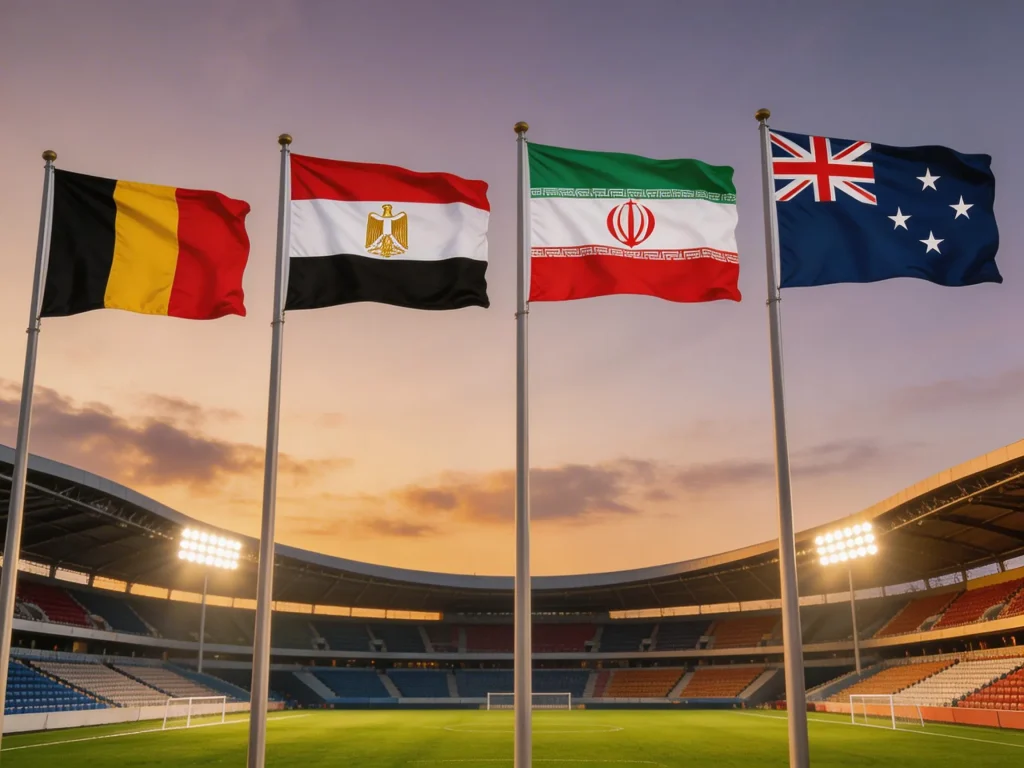
Table of Contents
I have covered nine World Cup group stages since 2018, and Group G at the 2026 FIFA World Cup is the kind of draw that makes an analyst sit forward. A golden generation winding down in Belgium, an Egyptian attack built around two of Europe’s most devastating forwards, a geopolitically volatile Iranian squad whose participation remains uncertain, and a New Zealand side returning to football’s grandest stage for the first time in sixteen years. This is not a group of death in the traditional sense — there is a clear favourite — but for NZ punters, it is the only group that matters.
All three All Whites matches fall between 15 and 26 June, with kick-off times translating to early afternoon in New Zealand. That scheduling quirk means most of the country can watch live without sacrificing sleep, a genuine advantage for building the kind of collective buzz that turns casual fans into punters. The group’s four-team dynamic, shaped by the new 48-team format, also introduces third-place qualification as a viable route to the round of 32 — a detail that changes how I assess every match in this pool.
Group G at a Glance
When the draw was finalised in December 2025, the immediate reaction across New Zealand betting circles was cautious optimism. Belgium topped Pot 1 based on FIFA rankings, Egypt slotted in from Pot 2 as the strongest African qualifier, Iran entered from Pot 3 with four consecutive World Cup appearances, and New Zealand came through Pot 4 via OFC qualifying dominance. On paper, the hierarchy looks settled. In practice, tournament football rarely respects hierarchy.
The format matters here. Under the new structure, the top two from each group advance automatically, and eight of the twelve third-placed teams also qualify for the round of 32. That means finishing third in Group G is not necessarily elimination. A team that collects three or four points — one win, or a win and a draw — could still progress depending on results elsewhere. For a side like the All Whites, whose realistic ceiling in most draws would be a respectable exit, this format injects genuine hope into every matchday.
All Group G fixtures take place across two venues: SoFi Stadium in Los Angeles and BC Place in Vancouver. New Zealand opens in LA, then plays their remaining two matches in Vancouver. The time zone spread between the two cities is minimal, but the climate shift from Southern California heat to Pacific Northwest cool could influence squad management and recovery windows.
Group G betting markets currently price Belgium at around 1.45 to win the group, Egypt at 3.20, New Zealand at 7.50, and Iran at 8.00 — though Iran’s odds carry an asterisk the size of a geopolitical crisis, which I will address separately.
Belgium — The Clear Favourite
There was a stretch around 2018 to 2022 when Belgium’s golden generation felt destined to win something. They did not. Roberto Martínez’s tenure ended after a limp 2022 World Cup, and Domenico Tedesco’s appointment brought tactical renovation but not immediate silverware. The squad that arrives in North America in June 2026 is a transitional one — and transitional Belgium is still more talented than 90 per cent of the tournament field.
Kevin De Bruyne remains the orchestrator despite entering his mid-thirties, and his ability to dictate tempo in group-stage matches where opponents sit deep gives Belgium an almost unfair advantage in games against lower-ranked sides. Jérémy Doku provides the pace and directness that De Bruyne’s through balls demand, and Romelu Lukaku, Belgium’s all-time leading scorer, offers a physical focal point that smaller defensive units struggle to contain.
Beyond the marquee names, Belgium’s depth in central midfield — Amadou Onana, Youri Tielemans, and the emerging Arthur Vermeeren — means they can rotate without losing control. Their vulnerability, such as it exists, lies at centre-back, where the retirement of Jan Vertonghen and Toby Alderweireld has left a gap that Wout Faes and Zeno Debast are still filling. Set-piece defending has been an issue in recent qualifiers, and that is exactly where a well-organised side like New Zealand could cause problems.
I expect Belgium to top Group G with seven to nine points. Their odds of 1.45 to win the group reflect a roughly 65 per cent implied probability, which feels about right. The value play here is not backing Belgium outright — those odds are too short — but rather exploring Belgium-related combination markets, such as Belgium to win the group and top scorer in the group to be a Belgian player.
Egypt — Salah’s World Cup Moment
Mohamed Salah missed the decisive penalty in AFCON 2022. He was injured for most of Egypt’s 2022 World Cup qualifying play-off against Senegal. The narrative of unfulfilled potential at international level has followed him for years, and this World Cup feels like the point where that narrative either flips or calcifies permanently. He arrives in the United States as one of the most decorated players in Premier League history, yet his World Cup CV reads: one appearance, one group-stage exit, and a shoulder injury that limited him to a substitute cameo in 2018.
The difference in 2026 is the supporting cast. Omar Marmoush’s breakout at Eintracht Frankfurt and subsequent move to Manchester City has given Egypt a second elite-level forward who can carry games independently. The Salah-Marmoush partnership, when deployed together in a 4-2-3-1, creates a dual threat that few Group G defences can neutralise simultaneously. Force a team to double-mark Salah and Marmoush exploits the space. Leave Marmoush one-on-one and his acceleration does the rest.
Egypt’s defensive structure under Hossam Hassan is built around compactness and transition speed. They conceded just four goals across ten AFCON and World Cup qualifying matches in 2025. Their weakness is depth: once you move past the starting eleven, the quality drop-off is noticeable, particularly in central defence and defensive midfield. Against Belgium, Egypt will likely sit in a medium block and counter. Against New Zealand, they will expect to dominate possession — and that is where tactical upset potential lives.
Group G odds price Egypt at around 3.20 to win the group and roughly 1.80 to qualify. Those numbers suggest the market sees Egypt as a comfortable second-place finisher, which I broadly agree with. The match against New Zealand on 21 June at BC Place is the fixture where Egypt’s odds carry the most variance — if Egypt are sluggish after a draining Belgium opener, and the All Whites are riding confidence from a potential result against Iran, the upset path opens.
Iran — Participation Uncertain
No analyst in nine years of covering World Cup betting markets has had to hedge a team preview with “if they actually play.” Iran’s situation heading into the 2026 tournament is unprecedented in modern football. The military conflict between the United States and Israel on one side and Iran on the other, which escalated from 28 February 2026, has created genuine doubt about whether Iran can or will participate in a tournament hosted primarily on American soil.
Iran’s Minister of Sport stated in March 2026 that participation was “not possible under current conditions,” though the Iranian Football Federation has not formally withdrawn. AFC expects Iran to fulfil their fixtures. FIFA has not issued a statement on replacement protocols should Iran withdraw. The ambiguity affects Group G’s betting markets in a fundamental way: if Iran withdraws, their matches are either forfeited 3-0 to the remaining opponents or a replacement team is introduced — and the betting landscape shifts entirely.
If Iran does play, they are a dangerous opponent. This is a squad that qualified for four consecutive World Cups, built around experienced professionals like Mehdi Taremi and a defensive system that is compact and difficult to break down. Iran’s 2022 World Cup performance — a 2-0 win over Wales and a competitive loss to England and the USA — demonstrated their ability to compete against teams ranked well above them. Sardar Azmoun’s partnership with Taremi in attack gives Iran a dual threat through the middle, and their ability to frustrate better teams with disciplined low blocks is well documented.
For NZ punters, the Iran uncertainty creates a specific question: do you bet on markets that include Iran, or do you wait? My recommendation is to watch for FIFA’s official ruling before placing Iran-related bets. If Iran plays, the 15 June opener at SoFi Stadium becomes the most important match in the All Whites’ tournament — a genuine 50-50 contest where the winner likely secures enough points to contend for third place at minimum. If Iran withdraws, New Zealand’s path to the round of 32 becomes significantly clearer.
New Zealand — The All Whites’ Mission
Sixteen years is a long time between World Cup appearances. The All Whites who walked off the pitch at Royal Bafokeng Stadium in Rustenburg in June 2010, unbeaten after three group-stage draws, are now retired, coaching, or commentating. The squad that travels to North America in 2026 is younger, more technically refined, and — critically — more familiar with the demands of top-level European football than any previous New Zealand group.
Chris Wood anchors the attack. His record at Nottingham Forest across three Premier League seasons provides something no previous All Whites striker could offer: proven output against the best defences in the world. Wood’s aerial ability, link-up play, and positioning inside the box make him the focal point of everything Darren Bazeley’s side does in the final third. He scored 14 Premier League goals in 2025-26, and his ability to convert half-chances — a skill honed across years at Burnley, Leeds, and Newcastle before Forest — gives New Zealand a genuine goal threat at set pieces and in open play.
Behind Wood, the midfield axis of Matt Stamenić and Joe Bell controls tempo, while Liberato Cacace provides overlapping width from left-back that stretches opposition defensive lines. Sarpreet Singh offers creativity from the number ten position, and Stamenić’s passing range from central midfield allows New Zealand to build from the back when opponents sit off. In goal, Oliver Sail or Alex Paulsen — the pecking order remains contested — will face more shots per game than any NZ keeper in recent memory, making that selection a genuine tactical variable.
New Zealand’s OFC qualifying campaign was dominant: 8-1 over Vanuatu, 8-0 over Samoa, 7-0 over Fiji, 3-0 over New Caledonia in the final. Those scorelines tell you about the quality gap within Oceania but nothing about how this squad performs against genuinely competitive opponents. The more instructive results came in March 2026 friendlies: a 4-1 thrashing of Chile with a rotated squad (encouraging) and a 0-2 loss to Finland where set-piece vulnerability was exposed (concerning). That Finland match revealed exactly the defensive fragility that Belgium and Egypt will look to exploit.
The betting market prices New Zealand at around 11/8 (approximately 2.38 in decimal) to qualify from the group — meaning the market sees roughly a 42 per cent chance of the All Whites reaching the round of 32. That number factors in the third-place qualification route. I think 42 per cent is fair, perhaps slightly generous, but the upside scenario — Iran withdraws, New Zealand beats Egypt, collects a point against Belgium — is plausible enough to make the All Whites a legitimate punt for NZ bettors looking for emotional and financial returns.
Group G Schedule in NZ Time
Every four years, New Zealand’s time zone turns World Cup viewing into a test of commitment. In 2022, group-stage matches in Qatar kicked off between 1:00 AM and 7:00 AM NZDT. In 2026, the North American hosting works in New Zealand’s favour — summer in the Northern Hemisphere means winter in New Zealand, and the NZST offset of UTC+12 translates most evening ET kick-offs into early afternoon the following day.
Matchday 1 — Iran vs New Zealand
The All Whites’ tournament opens on 15 June at SoFi Stadium in Los Angeles. Kick-off is 9:00 PM ET, which converts to 1:00 PM NZST on 16 June. A Monday afternoon in New Zealand — expect packed pubs and extended lunch breaks across the country. This is the match that sets the tone. A win here, and the All Whites control their own destiny. A loss, and the mathematics get difficult fast. SoFi Stadium holds over 70,000 and will likely feature a significant NZ travelling contingent alongside the Iranian diaspora in LA. The atmosphere should be intense.
Matchday 2 — New Zealand vs Egypt
Six days later, on 21 June, the All Whites face Egypt at BC Place in Vancouver. Same kick-off time — 9:00 PM ET, 1:00 PM NZST on 22 June. Vancouver’s Pacific time zone means the local start is 6:00 PM, a prime-time evening fixture. This match carries enormous weight: if New Zealand secured a result against Iran, Egypt becomes the gateway to qualification. If the opener was a loss, Egypt becomes a must-win. BC Place’s retractable roof ensures weather is not a factor, and the stadium’s 54,000 capacity means the crowd will be substantial.
Matchday 3 — New Zealand vs Belgium
The group concludes on 26 June at BC Place. Kick-off is later — 11:00 PM ET, which converts to 3:00 PM NZST on 27 June. By this point, group permutations may already have clarified who needs what. If Belgium have already secured top spot after two wins, they could rotate heavily, presenting a different proposition for the All Whites. Conversely, if the group is tight, this becomes a winner-takes-all scenario. The two-hour kick-off difference from the earlier matches means NZ viewers get a slightly later afternoon start — still comfortably within working hours, still a national event.
The +16 hour time difference from Eastern Time to NZST applies consistently across the group stage, and every All Whites match falls on a weekday afternoon in New Zealand. That is a significant advantage for viewership and, by extension, for the volume of bets placed on TAB NZ during those windows.
Group G Odds — Winner, Qualification, Match Outcomes
Nine years of tracking World Cup group-stage markets have taught me one principle above all others: the favourite almost always tops the group, but the second qualifier is where the value lives. Group G is no exception. Belgium’s odds to win the group sit at approximately 1.45 (implied probability around 69 per cent), and that price accurately reflects their squad advantage. I see no value in backing Belgium to top the group at those odds.
Egypt to qualify at 1.80 (implied 56 per cent) is similarly fair but not exciting. Where the market gets interesting is in the New Zealand-specific lines. The All Whites to qualify from Group G at around 2.38 (42 per cent implied) is the headline market for NZ punters. Break that down further: New Zealand to finish second in the group is priced around 5.00, while New Zealand to finish third is around 2.80. Given that eight of twelve third-placed teams advance, a third-place finish is the most likely qualification route — and at 2.80, that represents reasonable value if you believe the All Whites can collect four points.
Match-level odds tell a complementary story. Iran vs New Zealand on 15 June is priced as a near coin-flip if Iran participates: New Zealand around 2.60, draw at 3.10, Iran at 2.80. New Zealand vs Egypt on 21 June favours Egypt at approximately 1.90, with the draw at 3.30 and a New Zealand win at 4.50. New Zealand vs Belgium on 26 June is the widest spread: Belgium 1.40, draw 4.80, New Zealand 8.50. The draw against Belgium at 4.80 catches my eye — Belgium historically struggle to blow out organised defensive teams in group stages, and a 0-0 or 1-1 is not implausible.
For combination bets, the multi of New Zealand to beat Iran and draw with Belgium returns around 12.50 on a two-leg accumulator through TAB NZ. That is speculative but not absurd, and it is the kind of high-return, low-outlay punt that makes World Cup betting compelling.
Qualification Scenarios — How NZ Gets Through
I have modelled four realistic scenarios for the All Whites based on pre-tournament odds, historical group-stage patterns, and the new third-place qualification system.
The optimistic path: New Zealand beat Iran, draw with Egypt, lose narrowly to Belgium. That yields four points and a positive or neutral goal difference, almost certainly enough for second or a strong third-place finish. Under this scenario, the All Whites qualify comfortably for the round of 32.
The realistic path: New Zealand beat Iran, lose to Egypt, lose to Belgium. Three points, with qualification depending on goal difference and third-place comparisons across other groups. Historical modelling suggests that three points with a goal difference of -1 or better gives a third-placed team roughly a 60 per cent chance of advancing under the eight-best-thirds rule.
The narrow path: New Zealand draw with Iran, lose to Egypt, lose to Belgium. One point. Virtually eliminated unless other groups produce extremely unusual results — multiple three-way ties, for example. Not worth betting on.
The Iran-withdrawal path: If Iran forfeits, New Zealand receives three automatic points (assuming FIFA’s standard forfeiture protocol applies). The All Whites then need just a draw from their remaining two matches to reach four or more points, making qualification highly likely. This scenario currently has no defined odds because the situation remains unresolved, but it underscores why tracking FIFA’s ruling on Iran is essential for anyone betting on Group G.
Across all scenarios, the Iran match on 15 June is the fulcrum. Win it, and the tournament opens up. Lose it, and the All Whites need results against significantly stronger opposition to stay alive.
The Verdict on World Cup 2026 Group G
Group G is not the most glamorous pool at the 2026 FIFA World Cup, but it is the most emotionally charged for anyone reading this from New Zealand. Belgium will likely cruise through. Egypt have the firepower to secure second. Iran’s presence — or absence — reshapes the entire competitive landscape. And the All Whites, for all their underdog status, arrive with a squad better equipped for this level than any NZ team in history, a format that rewards third-place finishes, and a schedule that puts every match in prime NZ viewing hours.
The smart World Cup 2026 Group G bet for NZ punters is a measured one: New Zealand to qualify from the group at 2.38 offers a fair return with genuine upside. Layer that with a single-match punt on New Zealand to beat Iran at 2.60, and you have a two-bet strategy that covers the most likely path to the round of 32. For the full breakdown of All Whites odds and squad analysis, the New Zealand team preview goes deeper into every angle.
