
MetLife Stadium — World Cup 2026 Final Venue Guide
 Available in US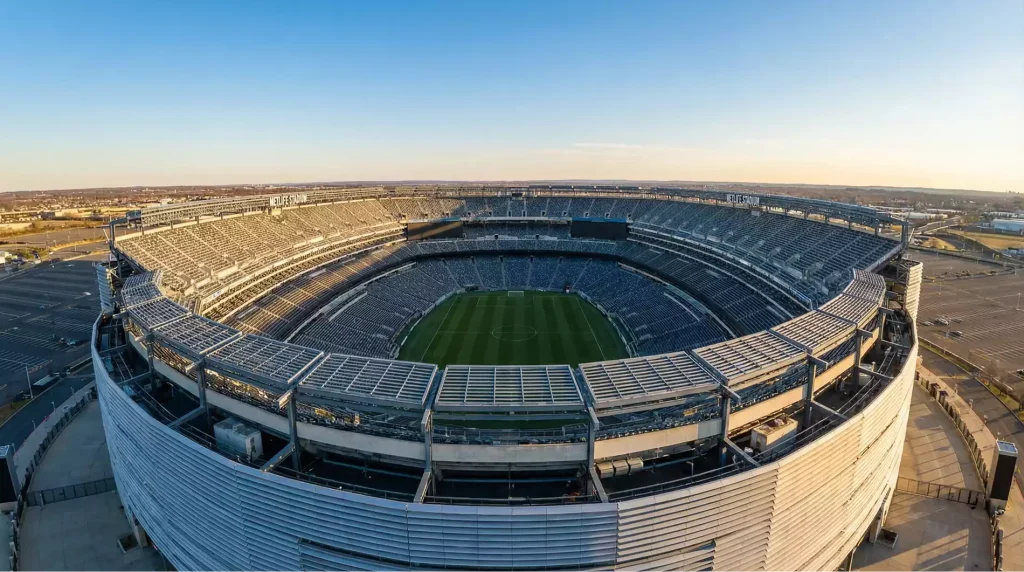
Table of Contents
On 19 July 2026, the referee’s whistle at MetLife Stadium will signal the end of the biggest World Cup in history. Forty-eight teams, 104 matches, and 39 days of football across three countries — all of it converging on a single venue in East Rutherford, New Jersey. For any NZ fan tracking the All Whites’ journey from Group G onwards, MetLife is the ultimate destination, the place where dreams either materialise or remain dreams for another cycle.
I have been to MetLife three times — twice for American football, once for an international friendly — and the stadium’s scale hits you differently than European grounds. It is wide, open, purpose-built for spectacle, and surrounded by the sprawling car parks and highway infrastructure that define American sporting venues. It is not charming. It is not intimate. But when 82,500 people are inside and the stakes are a World Cup Final, none of that matters.
About MetLife Stadium
The numbers behind MetLife tell the story of American sporting ambition. Opened in April 2010 at a construction cost of approximately $1.6 billion USD, it replaced the old Giants Stadium that had stood on the same site since 1976. MetLife serves as the shared home of both the New York Giants and the New York Jets of the NFL, making it one of only a handful of major stadiums worldwide that hosts two professional franchises simultaneously. Its official capacity sits at 82,500 for football configurations, though FIFA’s World Cup setup — with additional pitch-level seating and adjusted sightlines — may push that figure slightly higher or lower depending on the final layout.
The stadium sits in the Meadowlands Sports Complex in East Rutherford, Bergen County, New Jersey. Despite being marketed as a New York venue — and FIFA officially designating it under “New York/New Jersey” — it is technically across the Hudson River from Manhattan, about 13 kilometres west. This geographical nuance matters for NZ fans planning travel: you are staying in New York City but commuting to New Jersey for the match, and that commute involves either public transport, rideshare, or the legendary Meadowlands traffic.
MetLife is an open-air stadium with no retractable roof, which means the World Cup Final on 19 July will be played in whatever weather northern New Jersey delivers. July in the New York metro area averages highs of 30 degrees Celsius with humidity that makes it feel closer to 35. Evening kick-offs — the Final is expected at 4:00 PM ET (8:00 AM NZST on 20 July) — offer some relief, but heat management will be a tactical factor for both finalists. For reference, the 2026 World Cup has built extended cooling breaks into the regulations for matches played above certain temperature thresholds.
World Cup 2026 Matches at MetLife
FIFA assigned MetLife Stadium the tournament’s marquee fixtures. Beyond the Final on 19 July, the stadium is scheduled to host one semi-final, two quarter-final matches, and several group-stage games. The exact group-stage allocation depends on FIFA’s final scheduling matrix, but early indications suggest six to eight total matches at the venue across the tournament’s 39 days.
The concentration of knockout-round fixtures at MetLife reflects FIFA’s confidence in the venue’s infrastructure and its proximity to the tournament’s largest media hub. New York City houses the majority of international broadcast operations, and the short distance between Midtown Manhattan and East Rutherford means production crews, journalists, and officials can operate from a single base for the tournament’s final phase. For NZ punters, the practical implication is straightforward: if the All Whites reach the knockout rounds — and the 42 per cent qualification probability from Group G is real — there is a chance, however slim, of watching New Zealand play at MetLife in a quarter-final or beyond.
Group-stage matches at MetLife are expected to feature Pot 1 and Pot 2 teams from the North American groups, meaning high-profile fixtures involving the United States, Mexico, or other draw favourites. These games will serve as atmosphere-setters for the knockout rounds to follow, and the early-round crowds at MetLife tend to skew heavily toward the American and Latin American fan bases that dominate the New York metro area’s demographics.
The Final — 19 July 2026
Every World Cup Final carries its own weight, but this one comes with an asterisk that elevates it further: it is the first final in the expanded 48-team format, the first hosted in the United States since 1994, and the first played in a tri-nation tournament. The venue choice is deliberate — MetLife’s capacity, infrastructure, and location in the global media capital make it the logical centrepiece.
Kick-off is expected at 4:00 PM ET on Saturday 19 July. For New Zealand, that converts to 8:00 AM NZST on Sunday 20 July — an early morning start, but far more civilised than the 5:00 AM or 6:00 AM conversions that plagued previous World Cup finals held in European or Middle Eastern time zones. If the All Whites were somehow involved (current odds around 1500-to-1), the entire country would be awake regardless, but even as neutral viewers, the timing works for a Sunday morning gathering.
Security protocols for the Final will be the most extensive of any sporting event in 2026. The Meadowlands Complex sits adjacent to major highway interchanges and has hosted Super Bowls, WrestleMania, and international football matches, so the infrastructure for large-scale security operations exists. NZ fans attending should expect road closures, extended screening times, and restricted bag policies. Arriving three to four hours before kick-off is not excessive — it is standard for a World Cup Final at an American venue.
From a betting perspective, the Final is the single most liquid market in world football. Outright winner odds will have narrowed considerably by 19 July, but in-play betting on the Final generates enormous volume. TAB NZ typically offers live markets on World Cup Final match result, next goal scorer, total goals, and corners — all accessible from NZ during that Sunday morning window.
New York and New Jersey for NZ Fans
The first thing any Kiwi needs to understand about attending a World Cup match at MetLife Stadium is that “New York” in this context means “the greater New York metropolitan area,” which spans two states, three major airports, and a public transport network that is simultaneously world-class and infuriating. You will almost certainly base yourself in Manhattan or Brooklyn, commute to the stadium via NJ Transit rail or bus, and return to the city afterwards. Budget 90 minutes each way for the commute on match days — and double that if you are relying on rideshare apps, which surge-price aggressively around major events.
NJ Transit operates direct rail service from Penn Station in Midtown Manhattan to the Meadowlands Sports Complex on event days. The dedicated Meadowlands Rail Line runs express trains that take approximately 30 minutes, and FIFA is expected to expand service frequency for World Cup fixtures. This is the recommended route. The alternative — driving or taking a bus via the Lincoln Tunnel — adds traffic variability that can turn a 20-minute drive into a 90-minute crawl.
Accommodation in New York City during mid-July will be expensive regardless of the World Cup, but the tournament will push prices higher in Manhattan and the surrounding boroughs. NZ fans on a budget should consider Jersey City or Hoboken, both of which sit on the NJ side of the Hudson River, offer PATH train access to Manhattan, and provide easier road access to East Rutherford. A hotel in Jersey City puts you 20 minutes from the stadium by car on a non-match day and keeps you connected to NYC via the PATH system.
Food, culture, and nightlife in New York require no introduction, but one NZ-specific note: the time difference means your body clock will be 16 hours behind. Jet lag from New Zealand to the US East Coast is among the most brutal in global travel — you are essentially flipping your day and night. Arrive at least three days before the match to adjust, and avoid the temptation to power through the first day without sleeping.
Getting There from New Zealand
There is no direct flight from Auckland to New York. The standard routing involves a connection through either Los Angeles, San Francisco, or Houston, with total travel time ranging from 20 to 24 hours depending on the layover. Air New Zealand operates daily services from Auckland to Los Angeles and Houston, both of which connect onward to New York’s JFK or Newark airports via domestic carriers. Newark Liberty International Airport is the closest major airport to MetLife Stadium — roughly 20 kilometres — while JFK sits further east on Long Island.
For NZ fans attending multiple matches, a routing strategy matters. If the All Whites open at SoFi Stadium in Los Angeles on 15 June and then play in Vancouver on 21 and 26 June, a logical itinerary would be: Auckland to Los Angeles (match one), LA to Vancouver (matches two and three), Vancouver to New York (if the All Whites advance or if you are staying for the knockout rounds). Multi-city bookings through Air New Zealand or partner airlines allow this kind of routing without backtracking.
Visa requirements for New Zealand passport holders entering the United States include an approved ESTA (Electronic System for Travel Authorization), which should be applied for at least 72 hours before departure. The ESTA is valid for two years and covers multiple entries. New Zealand is part of the US Visa Waiver Programme, so the process is straightforward, but do not leave it until the last minute — application surges around major events can cause processing delays.
Budget-wise, a two-week trip from New Zealand to attend World Cup matches in the US should factor in approximately $3,000 to $4,500 NZD for return flights, $200 to $500 NZD per night for accommodation in the New York metro area, $150 to $800 NZD per match ticket depending on the round and seating category, and daily living expenses of $100 to $200 NZD in one of the world’s most expensive cities. The total for a New York-focused World Cup trip from NZ lands somewhere between $8,000 and $15,000 NZD — a significant investment, but one that buys you a front-row seat to football history.
What MetLife Means for the Tournament
MetLife Stadium is not the most beautiful ground at the 2026 World Cup. Estadio Azteca has the history. SoFi Stadium has the architectural ambition. BC Place has the mountain backdrop. But MetLife has the Final, and in tournament football, the Final venue becomes the symbol of the entire event. When the confetti falls on 19 July and a captain lifts the trophy in East Rutherford, that image will define the 2026 World Cup in collective memory — just as the Lusail Stadium defined 2022, and the Maracanã defined 2014.
For NZ fans, MetLife represents the ceiling of what is possible. The All Whites’ realistic target is the round of 32, and achieving that alone would be the greatest result in New Zealand football history. But sport runs on improbability, and every team that enters a World Cup carries, somewhere in the back of the squad room, the knowledge that 19 July exists. The full group-stage draw shows exactly what stands between the All Whites and that date in New Jersey.
