
USA at the World Cup 2026 — Home Advantage and Betting Odds
 Available in US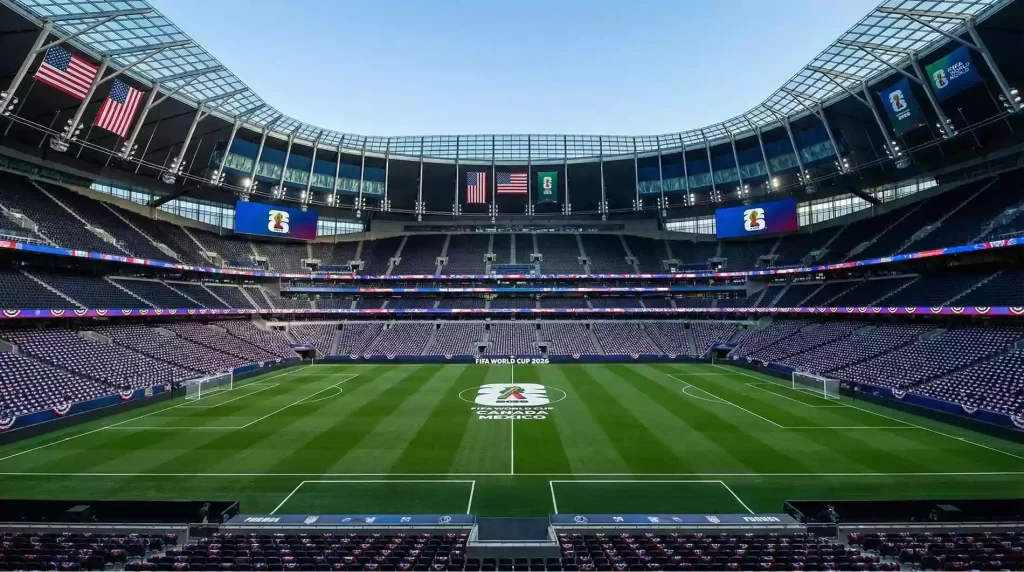
Table of Contents
Hosting a World Cup changes everything. The crowd, the travel advantage, the familiar pitches, the cultural energy of an entire nation tuned into football for five weeks — these factors do not show up in squad-quality models, but they show up in results. South Korea reached the semi-finals as hosts in 2002. Russia reached the quarter-finals as hosts in 2018. Brazil reached the semi-finals as hosts in 2014 before the trauma of the Germany match. The United States hosting the 2026 World Cup — with 11 of the 16 stadiums on American soil — places them in a position where the host-nation advantage could be the difference between a round-of-32 exit and a quarter-final run that captures the imagination of a country still learning to love the sport.
The Host Nation Factor
I built a model specifically for host-nation performance at World Cups, covering every tournament since 1990. The data is striking: host nations outperform their pre-tournament odds by an average of 1.5 rounds. A team expected to reach the round of 16 typically reaches the quarter-finals. A team expected to exit in the groups typically survives to the knockouts. The mechanisms behind this are well-documented — zero travel fatigue, familiar climate and pitch conditions, referee psychology influenced by crowd noise, and the morale boost of playing in front of a home support that outnumbers every opponent’s travelling fans.
For the USA in 2026, the host advantage is amplified by the co-hosting arrangement. While Mexico and Canada share the tournament, the United States hosts 11 stadiums and the vast majority of knockout-round fixtures, including the final at MetLife Stadium. If the USMNT advance to the later rounds, they will play every match in the United States, in front of American crowds, in stadiums they have played in dozens of times at club level. That familiarity — knowing the dimensions, the surface, the acoustics — is a marginal advantage that compounds across multiple matches.
The counter-argument is that hosting creates pressure as much as advantage. The expectation of an entire nation — and in the USA’s case, a nation where football is still proving itself against the NFL, NBA, MLB, and NHL — can weigh on young players unaccustomed to the scrutiny. The 2014 Brazilian squad buckled under the weight of home expectations in the semi-final. The USMNT squad in 2026 will be younger and less experienced at major tournaments than most host nations, and how they handle the psychological dimension of playing at home will matter as much as their tactical preparation.
The co-hosting format adds a wrinkle that pure host-nation statistics do not capture. Mexico hosts the opening match and three stadiums’ worth of group fixtures. Canada hosts two stadiums. The USA hosts the rest — including every knockout match from the quarter-finals onwards. This means that if the USMNT progress deep into the tournament, the home advantage intensifies with every round. A quarter-final in Dallas and a semi-final in Philadelphia would be played in front of overwhelmingly American crowds in stadiums the players know intimately from domestic football. That escalating home advantage is unique to this tournament structure and is not reflected in historical host-nation data, which treats the advantage as constant across rounds.
Squad — Pulisic, McKennie, Reyna
Christian Pulisic is the face of American football on the global stage, and his development at AC Milan has transformed him from a promising teenager into a genuinely world-class attacking midfielder. His movement, his finishing, and his ability to produce decisive moments in big matches — including his goal against Iran at the 2022 World Cup — make him the player the USMNT’s campaign revolves around. Pulisic at 27 is at his peak, and his comfort playing in high-pressure European matches translates directly to the World Cup environment.
Weston McKennie provides the midfield engine — box-to-box running, aggressive pressing, and an aerial threat from set pieces that gives the USA a physical dimension in central areas. His experience at Juventus, in Serie A’s tactical crucible, has refined his positional discipline and his understanding of when to press and when to hold. McKennie’s fitness across five weeks is a concern — his injury history at club level suggests he may need managing — but when available, he is the midfield heartbeat.
Giovanni Reyna represents the creative wildcard. His talent is undeniable — close control, vision, and the ability to play defence-splitting passes — but his career has been hampered by injuries and inconsistent form at Borussia Dortmund and beyond. A fit, firing Reyna gives the USA a number ten who can unlock organised defences. An unfit or out-of-form Reyna is a luxury the squad cannot afford. Yunus Musah adds dynamism in the middle of the park, and his dual-footed ability to progress the ball under pressure gives the USMNT a profile in midfield that few opponents expect from an American side.
The defensive structure has been the USMNT’s strength in recent years. Antonee Robinson at left-back provides Premier League quality and overlapping runs that stretch defences. Sergiño Dest or a newer option at right-back adds pace and attacking intent. The centre-back pairing — likely drawn from Chris Richards, Tim Ream (if still involved at 39), or a younger MLS-based option — needs to provide the solidity that allows the full-backs and midfielders to push forward. The central defensive partnership is where the USMNT’s depth is thinnest, and an injury to a first-choice centre-back during the tournament would force a significant quality drop that opponents in the knockouts would exploit. Matt Turner or a competitor in goal rounds out a squad that is competitive at World Cup level but lacks the depth of the top-tier contenders. The goalkeeper position has been a source of debate — Turner’s shot-stopping is reliable, but his distribution under pressure has been questioned at the international level.
Group D: USA, Paraguay, Australia, Turkey
Group D is the host nation’s proving ground. Paraguay are a typically combative South American side — organised, physical, and difficult to break down. They qualified through CONMEBOL, where every away point is earned through grit rather than grace, and their defensive structure will test the USMNT’s ability to break organised resistance. Australia bring the Australasia connection that NZ punters will follow closely, and their 2022 World Cup run (round of 16) showed that the Socceroos can compete at this level when the circumstances align. The trans-Tasman angle adds spice — NZ and Australian supporters will be tracking both Group D and Group G with equal intensity, and a scenario where both the All Whites and Socceroos reach the round of 32 would be an unprecedented Australasian achievement. Turkey, having qualified through the UEFA play-offs, are the group’s dark horse — a talented squad with Bundesliga and Premier League representation that could trouble any team on their day. Arda Güler’s creative talent and Hakan Çalhanoğlu’s midfield control give Turkey a quality spine that belies their play-off qualification route.
The USA are priced at approximately 1.80 to win Group D — shorter than their squad quality alone would justify, reflecting the host-nation premium. My model gives the USA a 45% chance of topping the group, with Turkey at 25%, Australia at 18%, and Paraguay at 12%. The home advantage tilts every fixture roughly 5-8% in the USA’s favour compared to a neutral venue, and across three group matches, that cumulative tilt adds up to a meaningful edge.
The Turkey match is the fixture that determines the group. If the USA beat Turkey at home — in a stadium where 70,000 American fans will create a deafening atmosphere — the remaining two fixtures against Paraguay and Australia become manageable. If they lose to Turkey, the pressure intensifies immediately, and the host-nation narrative shifts from “America’s World Cup moment” to “host nation in crisis” — a media-driven spiral that young players may struggle to handle.
USA’s Odds
At approximately 20.00 outright on TAB NZ, the USA are a speculative punt that depends entirely on the host advantage being worth more than the market prices in. The squad quality, in isolation, would warrant odds around 30.00-40.00 — the USMNT are not in the same class as Argentina, France, Brazil, or England on pure footballing merit. The host premium compresses those odds to 20.00, and the question is whether that compression is justified or whether the market is overvaluing home advantage for a team that has never progressed beyond the quarter-finals at a World Cup.
USA to reach the quarter-finals at approximately 2.50 is the bet that best captures the host-advantage thesis. Topping Group D (likely), beating a third-placed team in the round of 32 (manageable), and then winning one knockout match to reach the quarters — that is the three-match sequence the odds imply, and the home-crowd factor gives the USA an edge in each of those fixtures that purely neutral-venue analysis would miss.
Pulisic’s player markets are the sharpest individual angle. His anytime goalscorer odds in USA group matches should sit around 2.80, and his role as the team’s primary creative and goal-scoring threat gives him more involvement in chances than the odds reflect. Pulisic to score 2+ tournament goals at approximately 2.50 is a bet worth considering if you believe the USA reach at least the quarter-finals.
What Home Soil Means for the USMNT
The 2026 World Cup is the biggest sporting event the United States has hosted since the 1994 World Cup — a tournament that broke attendance records and kickstarted a football culture that has grown from a curiosity to a mainstream sport over three decades. The 2026 edition will be played in NFL stadiums with 70,000+ capacity, in cities with massive immigrant communities (Mexican fans in Houston, Colombian fans in Miami, Argentinian fans in New Jersey), and in a media environment where every match will compete with the NBA Finals and MLB summer for attention.
For the USMNT specifically, playing at home means something that transcends the tactical advantages. It means a generation of American players — many of whom left the USA as teenagers to develop at European clubs — returning to play the most important matches of their careers in the country they represent. The emotional dimension is real and, in my experience covering tournaments, it matters in tight matches where the next goal determines everything. The roar of 70,000 fans in Atlanta or Dallas or Los Angeles after a Pulisic goal creates a momentum shift that no tactical board can diagram.
For NZ punters, the USMNT represent a thematic bet. Backing the hosts at a World Cup is a time-honoured punting tradition, and the broader team rankings show that the USA’s squad quality — while not elite — is competitive enough to justify a deep run with home advantage factored in. The quarter-final market at 2.50 is where the value sits. Beyond the quarters, the USA’s chances diminish sharply as they encounter the top-tier contenders who will not be intimidated by the crowd.
