
World Cup 2026 Odds — Every Market, Every Match
 Available in US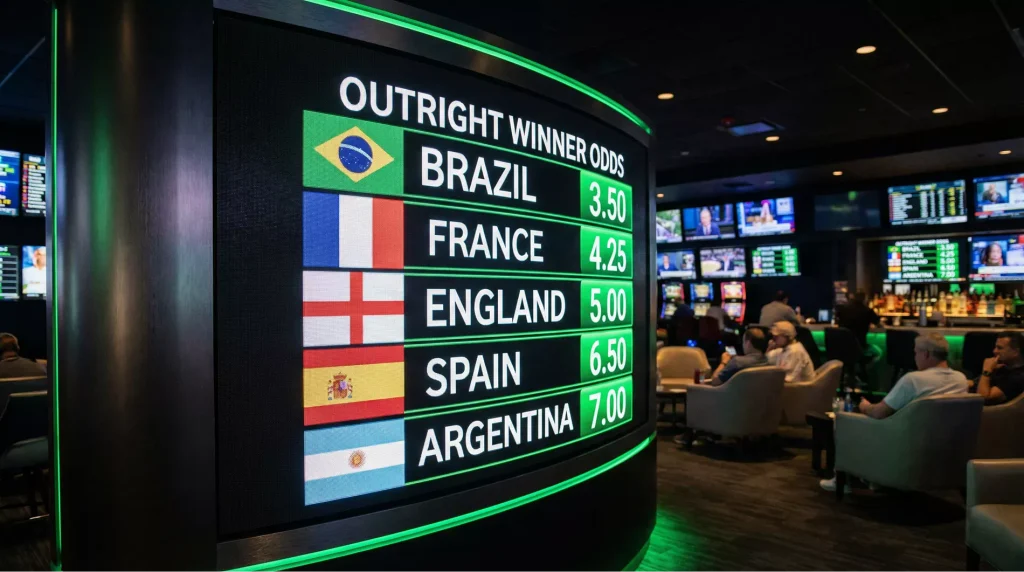
Table of Contents
Argentina at 4.50. France at 5.00. Brazil at 6.50. These numbers represent more than just prices — they encode everything the betting market believes about which nation will lift the trophy at MetLife Stadium on 19 July 2026. I have tracked World Cup odds through three tournaments now, and the pre-tournament numbers tell stories that unfold over 39 days of competition.
The world cup 2026 odds landscape differs fundamentally from any previous edition. Forty-eight teams instead of thirty-two means expanded betting markets across group winners, top scorers, and progression betting. Twelve groups instead of eight creates more permutations for accumulator bets and more complexity in identifying value. For NZ punters working through TAB NZ, understanding how these odds translate to probability — and where probabilities might be mispriced — determines whether you profit or pay across the tournament.
What follows is a complete breakdown of World Cup 2026 betting odds across every major market. From the outright winner down to All Whites specials, I cover what the numbers mean, where value might exist, and how these prices will move as kick-off approaches. Decimal format throughout, because that is what matters for punters betting legally in New Zealand.
Argentina holds the shortest outright odds at 4.50, reflecting their status as defending champions. France follow at 5.00, England at 6.00, Brazil at 6.50, and Spain at 7.00. These five nations account for roughly 55% of implied probability to win the tournament. The All Whites sit at approximately 1500.00 — a price reflecting near-zero probability but the only legal option for Kiwis wanting to back their own team going all the way. Group G sees Belgium as heavy favourites at 1.45 to top the group, with New Zealand’s advancement to the round of 32 available around 2.40.
Outright Winner Odds
The question I get asked most often before any World Cup: who should I back to win? My answer hasn’t changed in nine years of covering tournament betting — there is no universal right answer, only prices that do or don’t represent value relative to actual probability. Let me walk through how the market has priced the 48-team field.
Favourites Tier
Argentina entered the 2022 World Cup at approximately 5.50 and won. They’re shorter now at 4.50, which might seem like poor value given only two nations in history have defended the trophy successfully. But context matters: this Argentina squad features Lionel Messi at 38 still capable of tournament-defining moments, a midfield anchored by world-class Premier League talent, and a tactical system proven across multiple competitions. The price reflects genuine quality, not just narrative momentum from Qatar.
France at 5.00 represent the tournament’s deepest squad. Kylian Mbappé remains the planet’s most dangerous attacker, and France’s ability to replace injured stars without quality drop-off provides insurance that other nations lack. Their opening match in Group I against Senegal will establish whether the team carries the same hunger that delivered back-to-back final appearances in 2018 and 2022.
England’s odds have shortened to 6.00 following their Euro 2024 final appearance and the emergence of a genuine world-class generation. Jude Bellingham, Phil Foden, Bukayo Saka — these players peak during the 2026 window. Their Group L draw with Croatia presents a genuine test, but England haven’t faced a true “group of death” situation, which should help them arrive at the knockout rounds fresh.
Brazil at 6.50 feel like a team in transition. Their 2022 quarter-final exit to Croatia exposed defensive vulnerabilities that persist. The attacking talent remains extraordinary — Vinícius Júnior, Rodrygo, and Endrick form perhaps the most exciting young forward line in the tournament — but tournaments reward balance. I view Brazil as overpriced at 6.50 given their structural issues, though their ceiling remains trophy-worthy.
Spain round out the favourites tier at 7.00. Euro 2024 champions with perhaps the youngest elite squad in the competition. Lamine Yamal will be 18 during the tournament, Pedri 23, and their midfield control suffocated opponents through the European Championship. The concern: Spain have not won a World Cup knockout match since 2010. Their tournament pedigree since that triumph has been surprisingly poor.
Contenders Tier
Germany at 9.00 offer interesting value despite consecutive group-stage exits in 2018 and 2022. The Euro 2024 hosting appears to have rebuilt confidence, and their domestic-based core provides cohesion that touring nations sometimes lack. Playing matches across the US allows them to tap into significant German-American diaspora support, particularly at venues in the Midwest.
Portugal at 11.00 present the last realistic chance for Cristiano Ronaldo to win a World Cup. At 41, his role will necessarily be reduced, but the squad around him has genuinely improved since the 2022 quarter-final penalty shootout loss to Morocco. Bruno Fernandes conducting from midfield, Rafael Leão providing explosive pace on the wing — Portugal have routes to goals beyond their ageing talisman.
Netherlands at 13.00 look underpriced given their semi-final appearance in 2022 and consistent qualification through a difficult European campaign. Their direct playing style suits tournament football where controlling matches matters less than winning them. I have them ranked higher than their market position suggests, particularly if the bracket opens favourably.
Belgium at 15.00 are priced lower than any previous World Cup of their “golden generation” era. Kevin De Bruyne, Romelu Lukaku, and the remaining core players are older now, and this genuinely might represent their final shot. They’ve drawn Group G with Egypt, Iran, and New Zealand — a path that should deliver round-of-32 qualification with minimal stress, preserving energy for the knockout rounds.
Value Picks
Morocco at 25.00 retain most of the squad that reached the 2022 semi-finals, the best African performance in World Cup history. They’ve added depth without losing their defensive identity, and their Group C draw with Brazil, Haiti, and Scotland offers a genuine path to topping the group if Brazil stumble. At this price, they represent my favourite outright value.
USA at 30.00 benefit from host nation status — five World Cup champions won on home soil. The American squad features genuine quality in Christian Pulisic, Weston McKennie, and Tyler Adams, supported by a generation of players competing in top European leagues. Crowd support, climate familiarity, and reduced travel distances compound into meaningful tournament advantages.
Colombia at 45.00 returned from a decade of underperformance to impress through CONMEBOL qualification. Luis Díaz provides genuine world-class attacking threat, and their Group K draw with Portugal, DR Congo, and Uzbekistan offers advancement possibilities without facing elite opposition until the knockout rounds.
Group Winner Odds — All 12 Groups
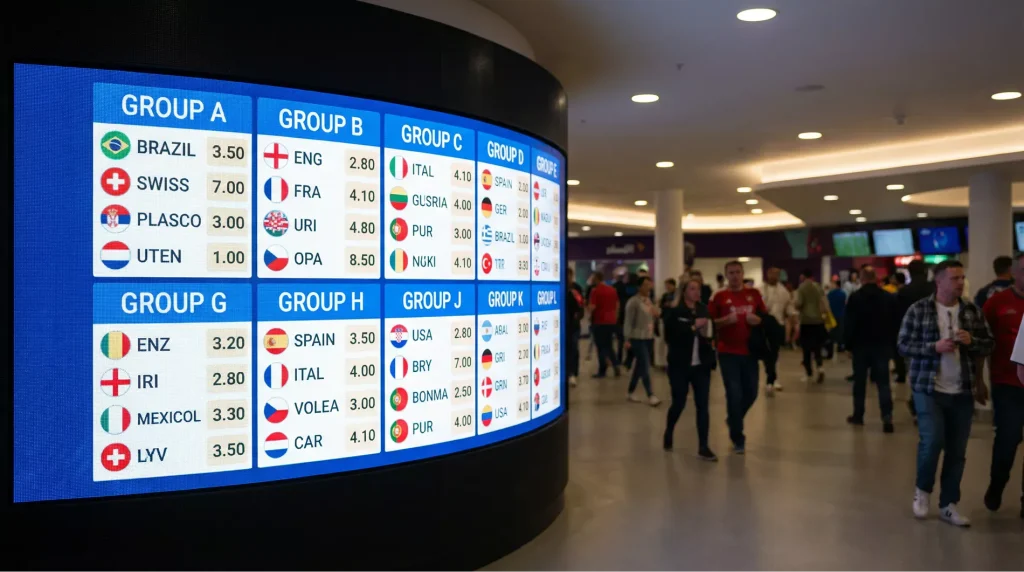
Group-winner betting requires understanding not just who the best team is but who the market thinks will finish first. These markets often contain more value than outright betting because casual punters ignore group dynamics entirely.
Group A features Mexico as co-hosts at 1.65, with South Korea their primary challenger at 3.50. South Africa and Czechia round out the group at longer prices. Mexico’s home advantage in their Estadio Azteca matches makes them justified favourites, though South Korea’s tournament pedigree and recent Asian Cup performance suggest their odds should be shorter.
Group B sees Switzerland at 2.10 as slight favourites over Canada at 2.30, with Bosnia and Herzegovina at 4.50 and Qatar at 7.00. This represents one of the tournament’s most open groups — any of the top three could realistically top it. I favour Canada given their home matches in Toronto and the improvement trajectory since their 2022 World Cup debut.
Group C pits Brazil at 1.40 against Morocco at 3.00, Scotland at 8.00, and Haiti at 35.00. Brazil should progress comfortably, but Morocco represent a live threat to top the group. Their defensive structure frustrates Brazilian attackers, as we saw in the 2022 quarter-finals when Morocco nearly kept them scoreless.
Group D places USA as heavy favourites at 1.50, followed by Turkey at 3.50, Paraguay at 5.00, and Australia at 6.00. The host advantage and objective squad quality justify the American pricing, though Australia’s improvement under Ange Postecoglou’s successor merits attention. The Socceroos historically overperform at World Cups relative to their ranking.
Group E features Germany at 1.35, a prohibitive favourite over Ecuador at 5.00, Ivory Coast at 6.50, and Curaçao at 50.00. Germany’s group stage price reflects expectations of dominant performances against modest opposition. The value here lies in Ecuador, a technically proficient South American side capable of challenging for second place and potentially snatching top spot if Germany rotate heavily in the final match.
Group F contains Netherlands at 1.55, Japan at 3.75, Sweden at 5.00, and Tunisia at 7.00. Japan troubled Germany and Spain in 2022 and shouldn’t be this long given their proven tournament capability. I view Japan at 3.75 as the clearest value in group winner markets — they could top this group without causing genuine shock.
Group G places Belgium at 1.45, Egypt at 3.50, Iran at 5.00, and New Zealand at 10.00. Belgium’s golden generation, despite age concerns, retains enough quality to expect them topping this group. Egypt’s attack featuring Mohamed Salah and Omar Marmoush makes them the obvious threat for second. Iran’s participation remains uncertain due to ongoing geopolitical developments, which adds unusual market volatility to this group.
Group H sees Spain at 1.40 dominating odds over Uruguay at 3.75, Saudi Arabia at 8.00, and Cape Verde at 15.00. Spain should cruise through this group, though Uruguay’s tournament experience and striker Luis Suárez’s potential farewell World Cup creates emotional wildcard potential.
Group I positions France at 1.30 as tournament-wide prohibitive favourites within their group over Senegal at 5.50, Norway at 7.00, and Iraq at 20.00. France’s price reflects the gap between them and opponents, though Senegal retain enough of their 2022 squad to present a meaningful challenge.
Group J features Argentina at 1.25 against Algeria at 6.00, Austria at 7.00, and Jordan at 25.00. Argentina’s pricing indicates near-certainty of topping the group. The value lies in Algeria, whose African Cup of Nations form suggests they could push Argentina closer than the market expects.
Group K includes Portugal at 1.60, Colombia at 3.00, DR Congo at 7.00, and Uzbekistan at 12.00. Colombia represent genuine value at 3.00 — they’ve beaten Portugal in recent friendly matches and their South American qualification campaign demonstrated improved consistency.
Group L completes the draw with England at 1.50, Croatia at 3.00, Ghana at 7.00, and Panama at 15.00. Croatia’s runner-up finish in 2018 and third-place finish in 2022 make them perennial knockout threats, and their 3.00 to top this group looks generous against an England side prone to slow tournament starts.
Top Scorer Odds
The Golden Boot race collapsed into chaos during the 2022 World Cup. Kylian Mbappé scored eight goals, the highest tournament total since Ronaldo’s eight in 2002, yet the market had him at 9.00 pre-tournament behind several “smarter” picks. Top scorer betting defies analysis more than any other World Cup market because goals cluster unpredictably and penalties distort individual tallies.
Mbappé opens at 6.50 for 2026, reflecting his 2022 dominance and France’s expected deep run. He takes penalties when Antoine Griezmann rests, plays every meaningful minute, and operates within a system designed to create his shooting opportunities. The price accounts for all these factors, which limits value.
Harry Kane at 8.00 won the 2018 Golden Boot largely through penalty conversions — six of his tournament goals came from the spot. England’s penalty-taking has since diversified, reducing Kane’s volume advantage. His all-round game contributes enormously to England’s chances, but for pure goal output, other options attract me more.
Erling Haaland at 9.00 enters his first World Cup with Norway as one of the tournament’s most dangerous finishers. The complication: Norway face France, Senegal, and Iraq in Group I, meaning Haaland’s minutes may be limited if Norway exit at the group stage. His goalscoring rate in limited matches would need to be extraordinary to contend.
Vinícius Júnior at 12.00 has evolved into a genuine goalscorer at Real Madrid without losing his creative instincts. Brazil’s style channels attacks through him, and their Group C draw against modest opposition should provide scoring opportunities. At 12.00, he offers value if Brazil reach the semi-finals or beyond.
Mohamed Salah at 15.00 leads Egypt’s attack in Group G, facing Belgium, Iran, and New Zealand. Three of those four matches should produce Egyptian scoring chances, and Salah’s conversion rate remains elite at 33 years old. His price reflects Egypt’s likely round-of-16 exit, limiting his total match volume. But at 15.00, a hot group stage could deliver value even without a deep run.
The structural change to 48 teams increases total tournament goals, which mathematically spreads scoring across more players. Historical Golden Boot winners typically scored 5–6 goals; the 2026 winner might need 7–8 given additional matches for teams reaching later rounds. I factor expected minutes into all top scorer analysis — a player on a team likely to play 7 matches has inherently better chances than one on a team likely to play 4.
All Whites Odds and Specials
New Zealand’s betting markets carry emotional weight beyond pure mathematical analysis. For Kiwi punters, backing the All Whites connects tournament investment to national identity in ways that backing Argentina or France simply cannot. I approach these markets with clear eyes about probability while acknowledging why these bets matter.
Outright tournament winner: approximately 1500.00. This price implies roughly 0.07% probability, which honestly might be generous. No OFC nation has ever advanced beyond the group stage, and New Zealand would need to defeat multiple top-10 nations across knockout rounds to lift the trophy. This is a bet for pure entertainment, not genuine expectation.
To qualify from Group G: approximately 2.40. This represents the meaningful market for NZ supporters. The All Whites need to finish in the top two or among the best third-placed teams across all 12 groups. Their path likely requires beating Iran, drawing with Egypt, and hoping results elsewhere create a favourable third-place comparison even if Belgium prove too strong.
Chris Wood top NZ scorer: 1.25. The Nottingham Forest striker is comfortably New Zealand’s most prolific option and will take any penalties awarded. At these odds, backing Wood feels like picking up pennies — the probability is high, but the return is minimal. More interesting might be specials on Wood scoring against specific opponents if TAB offers such markets.
New Zealand versus Iran match result: New Zealand opened around 2.75, with Iran at 2.50 and the draw at 3.20. Iran’s participation uncertainty complicates this market — if they withdraw, FIFA would need to determine replacement or forfeit procedures, potentially voiding existing bets. Wait for clarity before committing money.
New Zealand versus Egypt match result: Egypt around 1.85, draw at 3.40, New Zealand at 4.50. Egypt’s quality makes them rightful favourites, but this match offers realistic NZ upset potential. Salah tires, Egypt secure group position early, New Zealand play for their tournament lives — these scenarios push the draw probability higher than 3.40 implies.
New Zealand versus Belgium match result: Belgium approximately 1.35, draw at 5.00, New Zealand at 10.00. This fixture pits Group G’s clear favourite against its clear underdog. I view the draw at 5.00 as the only potentially valuable line — Belgium might rest players if already qualified, and NZ’s conservative tactical approach could frustrate until late. It’s a long shot, but 5.00 prices in more reasonable probability than 10.00 for an outright NZ win.
How Match Odds Work at the World Cup
Match odds seem straightforward until you realise how many variables influence those three numbers on your screen. Every price reflects a calculation incorporating team quality, recent form, historical matchups, venue factors, weather forecasts, injury reports, and betting volume from around the world. Understanding these inputs helps you identify when a price misses something important.
World Cup match odds settle on 90-minute results plus stoppage time. Extra time and penalties do not affect head-to-head betting — a match that finishes 1–1 after 90 minutes pays as a draw regardless of what happens subsequently. This distinction matters enormously in knockout rounds where perhaps 30% of matches go to extra time. If you want to back a team to advance regardless of whether they need extra time or penalties, look for “to qualify” markets instead.
Bookmakers set opening odds based on proprietary models combining objective factors and subjective assessment. These prices typically appear 7–10 days before a match and move based on betting activity and news flow. Early money from professional bettors often shapes odds movement; recreational money arriving closer to kick-off typically reinforces existing prices rather than moving them substantially.
For group-stage matches, draw probability averages around 25% — approximately one in four matches ends level. Tournament incentives explain this: teams protecting qualification positions often accept draws rather than risking defeat chasing victory. Knockout matches, by contrast, see draw odds at 90 minutes of approximately 22% — still significant, but slightly lower because neither team enters planning for extra time from kick-off.
Venue and climate affect odds more than casual observers realise. Matches in Mexico City at altitude challenge European teams unaccustomed to playing at 2,200 metres above sea level. Miami’s humidity drains even elite athletes by the 70th minute. These factors appear in odds through slight adjustments that might seem arbitrary but reflect genuine performance data from previous tournaments and continental competitions.
Understanding Odds Movement Before Kick-Off
I remember watching Germany’s odds for their 2018 World Cup opener drift from 1.25 to 1.40 in the 24 hours before facing Mexico. Something felt wrong — Germany were defending champions against a decent but unspectacular Mexican side. They lost 1–0. The odds movement had signalled information I didn’t possess at the time, possibly related to dressing room issues or squad fitness concerns that only emerged publicly later.
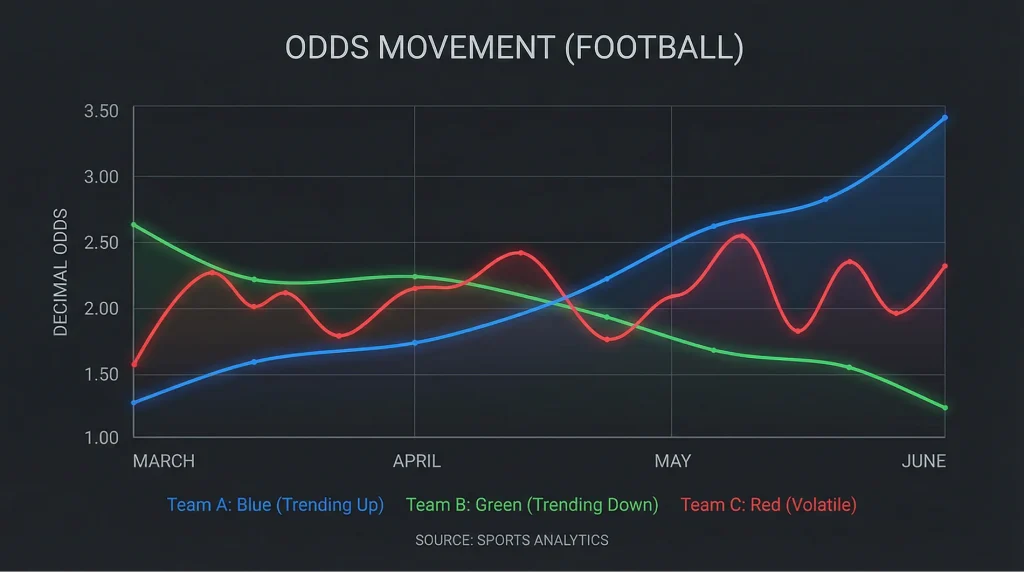
Odds movement tells you what informed money believes, not what public perception assumes. When a team’s price drifts against market expectations — getting longer when you’d expect them to shorten — pay attention. Professional bettors with access to superior information move markets before casual punters react. This doesn’t mean every drift signals a losing bet, but it demands investigation rather than blind confidence.
Pre-tournament outright odds follow predictable patterns. Favourites typically shorten slightly in the week before kick-off as casual punters place tournament bets, then stabilise once group matches begin. Upsets cause dramatic price swings — a favourite losing their opener sees their outright odds double or triple overnight. These reactive movements often overcorrect, creating value on teams with deeper squads capable of recovering from poor starts.
Line-up announcements drive significant odds movement for individual matches. A team’s odds might be set assuming their best eleven play, then shift dramatically when injury or rotation removes a key player. TAB NZ typically adjusts prices within minutes of official team sheets, which land 60–90 minutes before kick-off. If you’re confident in your assessment regardless of line-up, betting early captures potentially better prices; if you want to see confirmed squads, sacrifice some price for certainty.
Weather changes affect match odds in subtle ways. Rain forecast arriving after opening prices were set might lengthen odds on the technical passing team and shorten odds on the physical direct team. Extreme heat forecasts could shift under/over goal markets as endurance concerns increase. I monitor weather reports for all matches I’m considering and compare forecasts against the assumptions baked into current odds.
The concept of closing line value helps evaluate your betting skill over time. If you consistently bet prices that later move in your favour — meaning you bet Team A at 2.50 and they close at 2.20 — you’re capturing value the market eventually recognised. If your bets consistently show the opposite pattern, your analysis is lagging behind sharper money. Tracking your prices versus closing prices reveals more about edge than simply tracking wins and losses.
Where to Check Odds in NZ
New Zealand’s regulatory framework simplifies this question: TAB NZ is the only legal domestic option for sports betting. Their Betcha platform carries all World Cup 2026 odds for outright markets, group winners, match betting, and various specials. Checking elsewhere might reveal different prices, but you cannot legally bet those prices without accessing offshore operators — which violates NZ gambling law.
TAB NZ displays odds in decimal format across all markets. Their interface shows available markets for each match approximately one week before kick-off, with major tournament markets like outright winner available months in advance. Prices update continuously based on betting activity, though football markets may respond slower than horse racing or rugby markets given TAB’s traditional focus areas.
The TAB mobile app provides the most convenient access for NZ punters who want to check odds throughout the tournament. Push notifications for your preferred teams alert you to major odds movements, and the ability to place bets quickly matters when news breaks during NZST overnight hours while European analysts react during their working day.
One limitation worth acknowledging: TAB NZ’s World Cup coverage, while comprehensive for a monopoly operator, doesn’t match the market depth available through international bookmakers. Obscure player props, corner betting, and booking markets may be absent or limited. For the core markets that most punters care about — match results, group outcomes, outright bets — TAB provides adequate coverage at competitive prices.
What Makes a Value Bet?
Value is the only concept that separates long-term winning punters from long-term losing punters. Not picking winners — anyone can pick winners occasionally. Value means consistently finding situations where your assessed probability exceeds the implied probability reflected in odds. This sounds simple. It is extraordinarily difficult in practice.
Consider a match where New Zealand plays Egypt. The odds might be: Egypt 1.85, Draw 3.40, New Zealand 4.50. Converting these to implied probabilities: Egypt 54%, Draw 29%, New Zealand 22%. The bookmaker builds margin into these numbers — they sum to 105% rather than 100%. Your job is determining whether actual probabilities differ enough from these implied probabilities to create edge despite the margin.
If your analysis suggests New Zealand actually has a 27% chance of winning rather than the 22% implied by 4.50, you’ve found potential value. A $10 bet on New Zealand across 100 similar situations would theoretically return profit because you’re getting paid at 22% probability prices while actual probability is 27%. Of course, you won’t have 100 identical NZ versus Egypt matches — but the principle applies to any bet where your probability assessment exceeds implied probability.
Finding value requires honest self-assessment. Most punters overestimate their predictive accuracy because we remember our winning bets more vividly than losing ones. Keeping detailed records forces objectivity — what percentage of your bets at specific odds ranges actually win? If you bet 50 matches at odds around 2.50 and only 35% win instead of the expected 40%, you’re consistently overestimating underdogs and destroying value rather than capturing it.
World Cup betting offers value opportunities because casual money distorts prices. A nation with passionate fans bets heavily on their team regardless of realistic chances, shortening odds beyond fair probability. Backing their opponents — or the draw — captures value created by emotional betting. I specifically target matches involving teams with large betting populations who consistently overestimate their chances.
The uncomfortable truth about value betting: you will lose individual bets even when you’ve found genuine value. New Zealand at true 27% probability still loses 73% of the time. Value betting requires stomach for short-term losses while trusting that mathematics eventually deliver positive returns over sufficient volume. Tournament betting challenges this patience because volume is limited — 104 matches across 39 days, then nothing for four years.
Numbers That Tell the Story
World Cup 2026 odds will shift dramatically between now and the final whistle at MetLife Stadium. The prices I’ve detailed here represent a snapshot — useful for understanding market structure and identifying early value, but certain to evolve as injuries emerge, form fluctuates, and tournament matches generate new data.
For NZ punters, the practical takeaway is clear: understand what each price implies, compare that implication against your own assessment, and bet only where genuine value exists. The All Whites journey through Group G offers three matches worth analysing for value, regardless of patriotic attachment to outcomes.
